
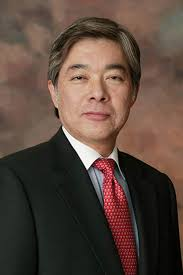
Glen S. Fukushima
Visiting Fellow, Stanford University
Vice Chairman, Securities Investor Protection Corporation
Senior Fellow, Center for American Progress
“Try new things and take prudent risks.”
Mr. Glen S. Fukushima first connected with the International House of Japan in 1971 and has had multiple contacts with the organization spanning over 50 years. When he was an exchange student at Keio University from Stanford University in 1971-1972, Keio Professor Fuji Kamiya wrote a letter to IHJ Managing Director Mikio Kato that allowed him to use the IHJ library. In 1979, when he was a student at the Harvard Business School, he was selected to participate in the Japan Business Fellows Program (administered by the IHJ and the Japan Society in New York), in which five MBA students from American business schools spent the summer in Tokyo working in Japanese companies. These positive experiences led him to register officially as an IHJ member in 1979. In 1982, when he was a Fulbright Fellow at the University of Tokyo, he started the Ph.D. Kenkyukai, a study group for American university students conducting dissertation research in Japan, and he arranged for the IHJ to host the group in an IHJ seminar room for its meetings. This Ph.D. Kenkyukai inspired other graduate students in Japan from both China and Korea to form similar study groups that the IHJ also hosted. Mr. Fukushima was an informal adviser to the IHJ in the early 2000s and served as an IHJ Trustee from 2013 to 2016.
Glen is currently a Visiting Fellow at Stanford University, Vice Chairman of the Securities Investor Protection Corporation, Senior Fellow at the Center for American Progress, and a philanthropist who has contributed to U.S.-Japan exchange at the Fulbright Commission, Japan-America Student Conference, Stanford University, and Harvard University.
We are so pleased that we had the opportunity to interview Glen and to learn more about his work and his connections to the International House of Japan.
Q. Looking back, is there a piece of advice that you have received that has been especially valuable in your professional and/or personal life?
Try new things and take prudent risks. For example, in high school I was accepted by the six colleges I applied to, but I chose to attend Deep Springs College, a private junior college established in 1917 and located in a desert valley in California with a unique curriculum of academic study, manual labor, and student governance. Often called the most selective American college that no one has heard of, the acceptance rate was under 2 percent, and the freshman class of 10 students had the second highest SAT average in the country (next to Caltech). My parents and friends advised me to attend one of the better known schools that had accepted me such as Stanford, Reed, and Pomona, but attending Deep Springs turned out to be one of the best life decisions I made.
Q. If you could summarize your experience with the IHJ in one word, what would it be?
Exchange. The IHJ is a fabulous venue and forum that allows for the exchange of ideas, activities, programs, and people between Japan and other countries, including especially the United States.
Q. If you could pass on a piece of advice to someone, what would it be?
I always advise students to study abroad. This gives you exposure to new ideas, new people, and new ways of thinking and doing. Your perspectives and horizons are broadened, you become more flexible and adaptable, and you end up understanding better your own country and culture in a global context.
Q. You have donated $1 million to the Fulbright Program to support American students to study in Japan and Japanese students to study in the United States, and $1 million to the Japan-America Student Conference. What do you think is the most important part of study abroad programs, and how do you think they can help shape future leaders in the U.S.-Japan exchange? What do you hope students would gain from these study abroad experiences?
I support study abroad programs because they help students become more open-minded, innovative, flexible, tolerant, and receptive to new ideas and new ways of doing things. To solve the global challenges we face, we need global cooperation. It is hard to fully understand others or to work effectively with them if you are confined only to your own country or culture. Studying abroad equips students to expand their ability to cooperate with others across countries, cultures, religions, and other borders and barriers.
Q. Philanthropy has shaped a lot of your experiences and actions, especially as it relates to investing in human capital through scholarships and education. What advice would you give individuals considering donating to an organization, and how would you describe the importance of philanthropy?
People have different reasons for making charitable contributions. In my case, I have in the past contributed to activities I consider important – art, music, film, wine, and politics. But in my old age, I’ve come to the conclusion that education is key for the future of our country, our world, and our planet. Educating the next generation to be global in their outlook, values, and work styles is key to solving the many challenges we face.
Q. With the 80th anniversary of the conclusion of World War II occurring last year in 2025, what do you hope will be the future of U.S-Japan relations? How can AFIHJ and IHJ collaborate to ensure the flourishing of that relationship?
The relationship between the United States and Japan since the end of World War II has been remarkably successful and beneficial to both countries and the world. However, there is a tendency to take the relationship for granted, and there is a need to update and renew the relationship to adjust to changes in the global environment. This requires conscious effort by both countries. Although the national governments of the two countries set the framework and tone of the relationship, there is much that the local governments (such as states, prefectures, and cities) and nongovernment actors (such as corporations, educational institutions, the media, NGOs, and NPOs) can do to strengthen the ties between the two countries. The IHJ and AFIHJ can play a vital role in this effort.
Q. What has interested you the most, or made you the most excited, about the work AFIHJ does?
AFIHJ plays an essential role in expanding IHJ’s activities outside of Japan and allows for those residing in the United States and Canada to engage more deeply with the IHJ and to support its activities without being physically present in Japan.
Q. What are a few discussion topics or projects you would like to see the International House of Japan engage more both in Japan and in North America? Are there any topics you are passionate about or care about that you would like to see the International House address?
As someone who worked at USTR (Office of the United States Trade Representative) for 5 years and was a business executive for 22 years, I would be interested in the IHJ focusing more attention on economic issues like trade, investment, finance, technology, and business. The IHJ has had many programs on politics, policy, culture, education, etc., but the importance of the economy is likely to grow, which is one of the reasons that I’m spending this year as a Visiting Fellow at Stanford University doing research on the ties between Silicon Valley and Japan.
Q. What is a question you never get asked, but would love to answer?
When I spoke recently at a conference in San Francisco on U.S.-China relations, about 30 percent of the participants were Chinese Americans. When I attend events on U.S.-Korea relations, many Korean Americans participate. When I attend events on U.S.-India relations, many Indian Americans participate. Why is it that when I attend events on U.S.-Japan relations, I am often the only Japanese American participant? I have the answer, but it’s not what most people think.